← Blog · AI
What If the Paycheck Became Optional?
Expertises will be nearly free, what can we do?
 Dominique Wu

I teach a class where, every semester, someone asks me a version of the same question. Not “how does this work,” but “will this still be a job when I finish the class?”
I never have a clean answer. I have a real one: I don’t know, and
neither does anyone selling certainty about it.
So I’ve been sitting with a prediction I heard recently from Vinod
Khosla. In an interview I watched, he argued that AI could eventually
take over about 80 percent of human labor. That number is his, not mine,
and I’d encourage you to watch him say it in context rather than take my
summary of it. What struck me wasn’t the figure. It was that he doesn’t
treat it as a catastrophe. He treats it as the setup for a world where
you live on your passions instead of your paycheck.
I want to believe that. I also build things for a living, which means I
spend most of my time in the gap between a vision and the Tuesday
morning it has to survive. Here’s where I landed on three of his ideas,
and where I think the friction is. Expertise gets close to free. The
argument is that as intelligence becomes ubiquitous, the cost of the
things we currently ration collapses. World-class tutoring. Real
diagnostic medicine. Legal help that doesn’t start at four hundred
dollars an hour.
I see the first tremors of this in my own work. At LitStage we build
immersive learning experiences, and the cost curve of something like a
simulated patient encounter or a hands-on equipment scenario has bent
hard in two years.
What used to require a studio, a production budget, and a six-month
timeline is now something a small team can stand up in weeks. The
expertise embedded in that scenario, the clinical judgment, the safety
protocol, the instructional design, used to be the expensive part. It’s
getting cheaper fast.
But cheap is not the same as distributed.
In the California community college system, where I work as an AI Fellow, the constraint has rarely been that good instruction is theoretically unaffordable. The constraint is that a student is working thirty hours a week, sharing a laptop, on a campus whose IT budget was set in a different decade. Free expertise sitting behind a device someone doesn’t own is still gated. The abundance story skips the plumbing, and the plumbing is most of the job.
Now is the time to find your ikigai.
His point here is that when basic needs get met easily, passion becomes the compass. Without one, you drift.
I think that’s right, and I think it’s the part of the argument most
likely to be misread as a permission slip. Ikigai isn’t a mood. In
practice it’s the intersection of what you love, what you’re good at,
what the world needs, and what someone will pay for. Khosla’s version
quietly deletes that fourth circle. That’s a beautiful idea for the
world on the other side of the transition. It’s cold comfort to the
forty-three-year-old in my classroom who is retraining because a job
disappeared and who needs the fourth circle to hold for another twenty
years.
So I’d add a clause. Find your ikigai, and in the meantime, build the
thing only you would build. Not because passion pays, but because in a
market where competent output is nearly free, the only durable asset is
a point of view. Taste, judgment, the ability to know what’s worth
making. That’s what I keep telling my students, and it’s what I keep
telling myself when I’m tempted to let a model make a decision I should
be making. Your voice matters more, not less. Khosla expects unicorns
run by one or two founders with AI doing the rest. I don’t doubt it.
I’ve felt the leverage personally. Work that would have needed a team of
eight now moves with a handful of people and a stack of tools.
The uncomfortable implication is that leverage concentrates. A world of
one-person unicorns is also a world where fewer people are in the room
when the defaults get set. Which is exactly why he lands on speaking up,
and why I think it’s the most actionable of the three.
Most of the policy that will govern how AI shows up in American
education isn’t being written in Washington. It’s being written in
curriculum committees, in accreditation language, in the procurement
rules of a district buying its first AI tool. Those rooms are small and
chronically underattended. If you have a perspective and you’re not in
one of them, the defaults will be chosen by whoever bothered to show up.
Where I actually land, I’m with him on the direction. The cost of
capability is falling in a way that will feel, in retrospect, like a
phase change. And I’d rather work from an optimistic frame than a
fearful one, because fear builds nothing.
But utopian and dystopian aren’t the only two options. The likeliest
outcome is neither, and it’s the one nobody makes a documentary about: a
long, uneven, unglamorous transition where abundance arrives for some
people years before it arrives for others, and the whole question is
what we do in that gap.
That gap is my job. It’s what the fellowship is for, it’s what LitStage
is for, and it’s the part of the story that doesn’t fit in a headline
about AI making paychecks optional.
The revolution isn’t really about the code. It’s about who gets carried
through the middle.
Watch the full interview:
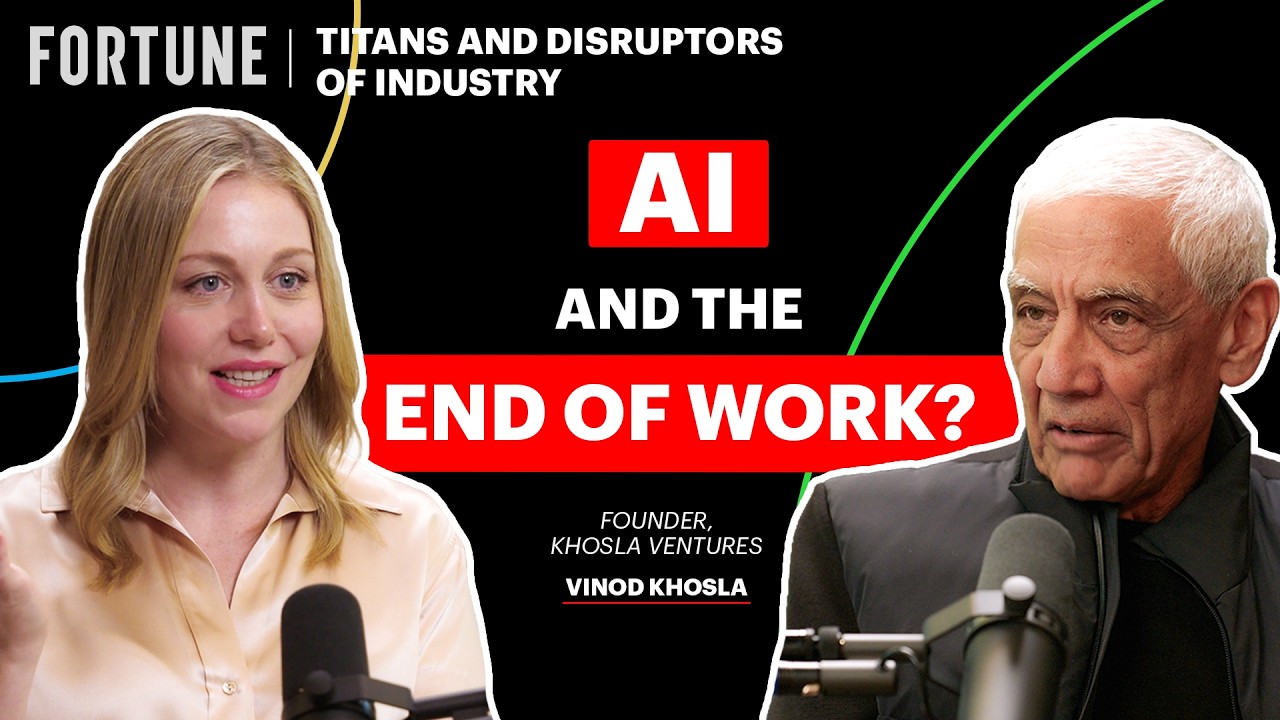 The End of Work: Vinod Khosla's Bold AI Prediction | Titans and DisruptorsFortune Magazine · YouTubeWatch on YouTube