← Blog · Spatial AI · XR · World Models · Robotics · Education
AI Is Learning Its Way Around
Glasses, world models, and robots are starting to connect. Here’s what looks useful, what still looks early, and why educators should pay attention.
 Dominique Wu
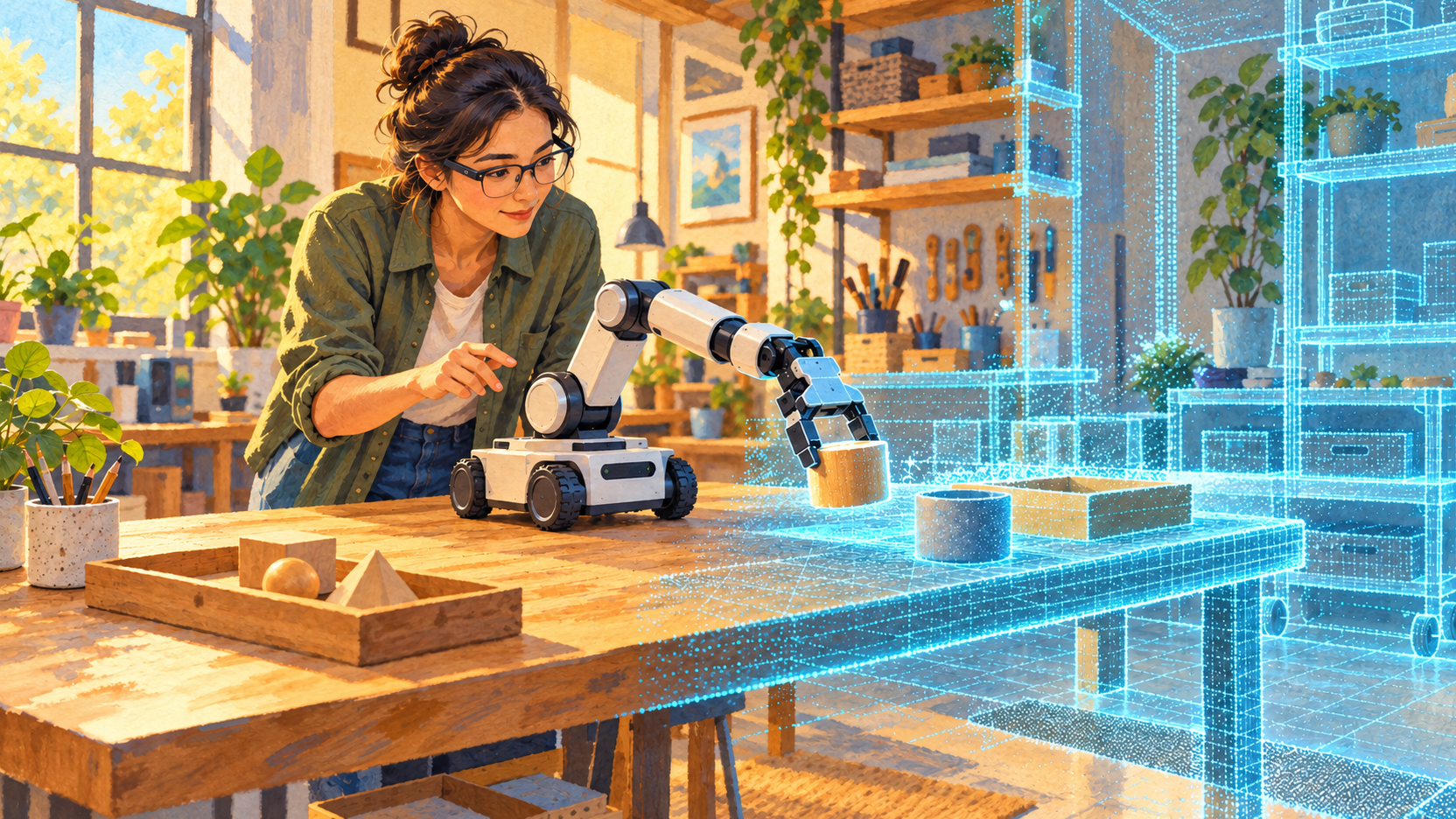
A pair of glasses. A robot carrying a warehouse tote. A digital room you can walk through.
At first glance, they belong in different conversations. One is a gadget, one is a machine, and one is something you might build for a game.
But underneath, they share a surprisingly practical question: can AI understand what’s around it well enough to help?
That’s the spatial AI story I’m watching this fall. AI is getting better at describing the world. The harder job is figuring out where things are, what might happen next, and what to do about it.
I think glasses, immersive environments, world models, and robotics will increasingly grow together. They won’t all run on one magic model. They’ll need different systems that work together, and plenty of testing when those systems meet real people.
Here’s my read on where this is going. The market estimates are approximate, the company reports deserve scrutiny, and the predictions are mine. I could be wrong!
Glasses have momentum
Glasses have a straightforward advantage: people already know how to wear them.
In its June 2026 market update, IDC estimated that smart glasses without displays shipped about 2.25 million units in the first quarter, up 167% from a year earlier. It also forecast that optical see-through display glasses would grow from roughly 3 million units in 2026 to 12.2 million in 2030. That second number is a forecast, not a future we’ve already booked. Source: IDC
These categories matter. Glasses with a camera and speakers offer a different experience from glasses that place information in your view. And both are different from a headset that surrounds you with a virtual environment.
My bet is that AI glasses have the stronger path to everyday use. Immersive headsets will earn their place in situations where being inside an experience really helps: training, design review, simulation, and games.
There’s room for both. A student practicing a difficult procedure and someone asking for directions don’t need the same device.
The questions I’d watch are wonderfully ordinary. Are the glasses comfortable? Does the battery last? Can people nearby tell when recording is happening? Is the assistance useful enough to justify another thing to charge?
World models need a better question
“World model” is becoming one of those terms that can fill an entire conference without everyone meaning the same thing.
Some systems generate environments. Others predict how a scene could change. Some are designed to help an agent test possible actions. Calling them all world models doesn’t make their capabilities interchangeable.
The question I find useful is: what can this system actually let us try?
Waymo introduced its World Model in February 2026 for driving simulation. The company describes generating camera and lidar data, changing weather and scene layouts, and testing alternative driving actions. That is a concrete use case for asking what might happen before encountering a situation on the road. It remains a company-reported capability, not proof that every generated scenario accurately represents reality. Source: Waymo
The distinction also helps when reading product news. OpenAI’s Sora web and app experiences ended April 26, 2026; its help page listed September 24 as the API discontinuation date. The closure is a reminder that promising research and a sustainable consumer product are different challenges. Source: OpenAI
My expectation is that useful systems will combine language, spatial perception, simulation, and task-specific controls. Which piece does which job will depend on the problem.
A believable world still needs grounding
Imagine an AI-generated workshop with beautiful lighting and every tool neatly arranged.
Lovely. Now ask whether that valve is in the right place, whether the scale is accurate, and whether the student can actually turn it.
That’s where the work gets interesting.
Niantic Spatial argues that language models and world foundation models need a grounding layer built from real-world spatial data. Its proposed combination includes a large geospatial model that helps machines locate themselves and understand their surroundings. It’s the company’s approach, not an agreed blueprint for all AI. But I agree with the underlying point: plausible scenery and reliable knowledge of a particular place are different things. Source: Niantic Spatial
For creators, tools such as World Labs’ Marble already offer generated worlds and export options including Gaussian splats and meshes. Those formats make it possible to bring a scene into other workflows. They don’t automatically supply accurate physics, meaningful interactions, or a finished lesson. Source: World Labs
I expect environment creation to get easier. The harder questions will increasingly be about what happens inside the environment, and how we know it works.
Robots are doing real work in specific places
There are meaningful deployments to discuss without turning every factory into a robot takeover story.
GXO’s commercial agreement with Agility Robotics dates to June 2024. It describes Digit moving totes within a warehouse workflow, alongside other automation. That’s a useful reminder that deployment started before this year, and that a bounded task can be valuable. Source: GXO
BMW’s September 2026 report says Figure 02 handled more than 90,000 components during a ten-month Spartanburg pilot. The same article describes Figure 03 as the successor for a logistics sequencing project. That gives us a useful record of a specific job, alongside a next step whose results are still worth watching. Source: BMW
Hyundai’s January announcement, meanwhile, set a goal of production capacity for 30,000 robots annually by 2028, with Atlas deployment planned to begin with sequencing tasks in 2028. Capacity targets and rollout plans are different from robots already working on a production line. Source: Hyundai Motor Group
Software is an important part of the progress. Vision-language-action models, such as Google DeepMind’s Gemini Robotics, connect visual information and instructions to robot actions. Hardware reliability, safety, and maintenance still have to keep up. Source: Google DeepMind
My bet for 2027 and 2028: the interesting numbers will be uptime, human interventions, and cost per useful task. Sometimes a human-shaped robot will fit the job. Sometimes wheels or a fixed arm will be the sensible answer.
What educators can do with this
The practical opportunity is giving students better ways to practice and explain decisions.
For an electrical lesson, a simulated workspace could let learners identify hazards before touching equipment. In a literature class, a reconstructed setting could become something students question: which details come from the text, and which did the system invent?
Start with one learning goal and one small activity. Ask students to predict, act, and explain what changed. Check the environment with a subject expert. Provide an accessible alternative. Compare what students learned with a simpler version of the activity.
A gorgeous room can still contain a weak lesson.
Over the next three to five years, I expect more connections between the tools we wear, the environments we build, and the machines doing physical work. Funding hype, compute costs, and disappointing deployments could slow that down.
For now, I’d keep asking a very human question: does this help someone understand something, make a better decision, or practice more safely?
That’s a future worth building toward.