← Blog · Emerging Tech
Robot Learning #1: Topology Dimensions and C-Space
What's Topology?
 Dominique Wu
What is topology, and why is it important to learn for robotics?
I first ran into topology while working on some 3D model projects. In Tripo AI there is a Topology function that lets me change the face and vertex counts of a mesh, so that is the meaning of the word I know.
Now I have started learning robotics, and the online courses I found all open with topology. I do not understand why. Is this the same thing I was doing in Tripo, or something different?
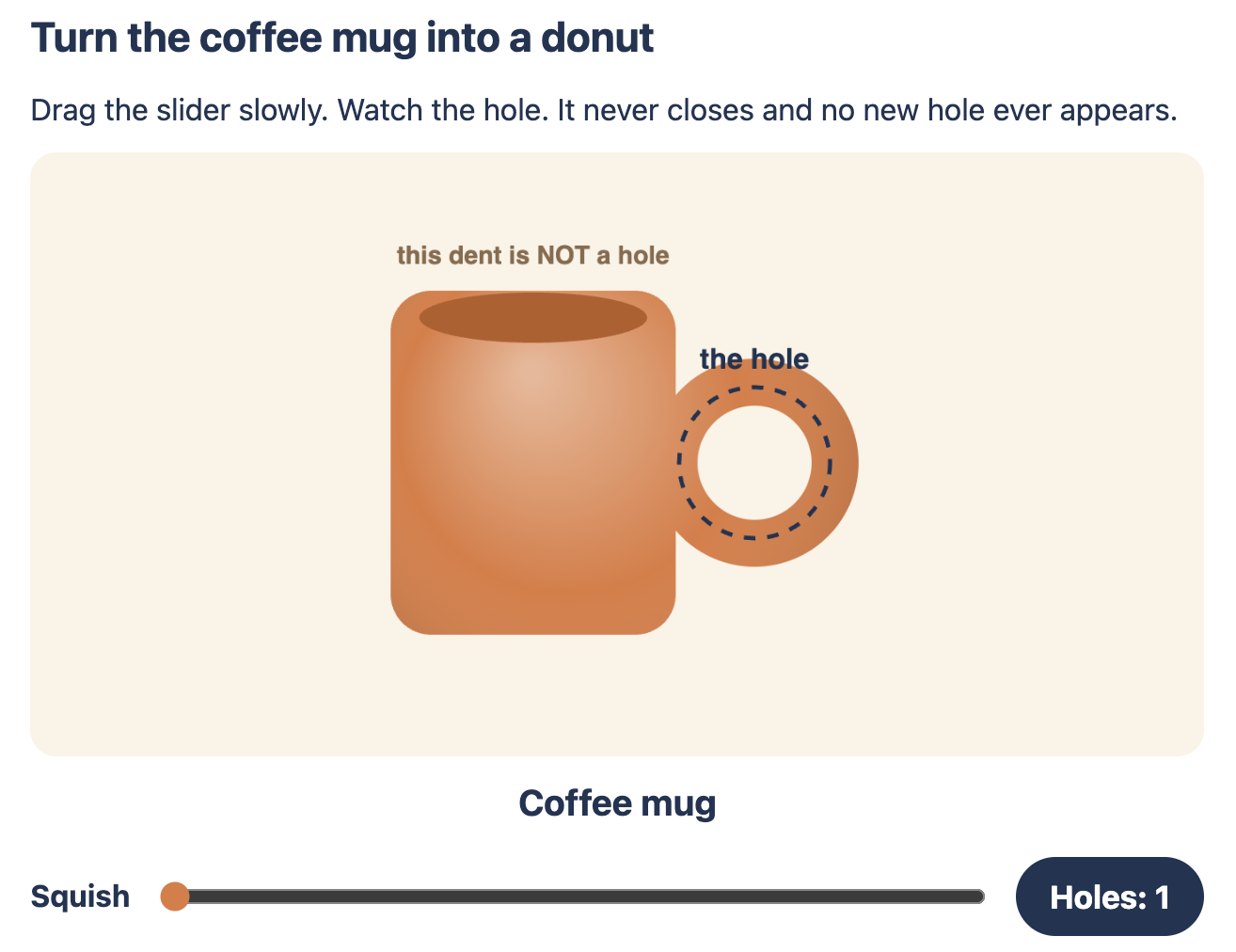
Topology is the study of what stays true about a shape when you squish it.
Distances change, angles change, size changes. What survives is: how many separate pieces there are, what is connected to what, how many holes of each kind, and how many dimensions. That is it. Everything in the two playgrounds was one long demonstration of that single idea.
Now the part that actually matters to you.
Why robotics cares
1. A robot’s set of possible poses is a space, and that space is usually not flat.
This is the big one. It is called configuration space, or C-space. Every possible pose of a robot is one point in it.
- One joint that spins all the way around is not a line from 0 to 360. It is a circle. 0 and 360 are the same point. Write your planner as if it were a line and the arm takes the long way around, or your interpolation jumps.
- Two such joints give a torus, a donut surface, not a square.
- A 6-joint arm gives a 6-dimensional torus.
- A wheeled robot on a floor is position plus heading, so R² × circle.
- A free-floating rigid body in 3D is position plus orientation, and the orientation part SO(3) is topologically real projective 3-space, RP³.
2. Gimbal lock is a topology fact, not a bug you can code around.
Because SO(3) has the topology it has, there is no way to cover all rotations with three angles without hitting a singularity somewhere. Euler angles will always lock. That is why the field uses unit quaternions, which live on the 3-sphere S³ and cover SO(3) two-to-one, which in turn is why q and −q are the same rotation. That doubling is a topological consequence, not a convention someone chose.
There is also a known result that no continuous time-invariant feedback can globally stabilize attitude on SO(3), which forces hybrid or switching controllers. I believe the standard reference is Bhat and Bernstein on topological obstruction to global stabilization of rotational motion, but verify the citation before you use it.
3. Obstacles punch holes, and holes create genuinely different routes.
Going left of a pillar and going right of a pillar are not two versions of one path. They are two different classes that cannot be deformed into each other. That is homotopy, straight out of the donut lesson. It matters for tethered robots, cable routing, multi-robot untangling, and any planner that needs to know whether it has really found a different option or just a wiggle of the same one.
4. Maps. SLAM systems often keep a topological map, a graph of places and how they connect, alongside the metric map. Loop closure is literally the robot detecting that its path formed a loop.
5. Mechanism structure. Serial arm, parallel delta, closed loop, tree-shaped humanoid. That link-and-joint graph is called the mechanism’s topology, and it determines the degrees of freedom and whether closed-form inverse kinematics even exists.
Okay, after learning about the topology, now you might want to ask, what are the dimensions? And what’s n-dimensional space? And what’s the difference between 6 v.s. 8 dimensions?
Dimension is just this: how many numbers do I have to tell you so you know exactly where I am?